Loading article
Back to Health Guides
What AHPRA-Registered Means for Doctors in Australia
What AHPRA registration proves, what it does not prove, how to check the public register, and why registration type matters.
8 min read
·Updated 3 June 2026
·Doctor Reviewed
AHPRA Verified
In this article
- 1What AHPRA Registration Means
- 2What AHPRA Registration Does Not Mean
- 3How To Check A Doctor On The Public Register
- 4What To Look For In The Result
- 5Registration Types Explained
Medical information only. This article is for general information and does not constitute medical advice. Treatment decisions are made by an AHPRA-registered doctor after reviewing your circumstances.
Jump to section
1What AHPRA Registration Means2What AHPRA Registration Does Not Mean3How To Check A Doctor On The Public Register4What To Look For In The Result5Registration Types Explained6Renewal, CPD, And Ongoing Standards7Good Medical Practice Still Applies8What This Means For Telehealth9Red Flags When Checking A Service Or Practitioner10If You Have A Concern11Practical Checklist12Sources
"AHPRA-registered" should not be treated as a decoration on a website. It is a checkable regulatory status.
Ahpra is the Australian Health Practitioner Regulation Agency. It works with 15 National Boards to run the National Registration and Accreditation Scheme. That scheme regulates 16 health professions, including medical practitioners, nurses, pharmacists, psychologists, physiotherapists, dentists, paramedics, and others.
For doctors, the relevant Board is the Medical Board of Australia. Ahpra handles the public register and regulatory administration; the Medical Board sets and applies professional standards for medical practitioners.
What AHPRA Registration Means
For a doctor, AHPRA registration means the practitioner appears on the public Register of practitioners and is allowed to practise medicine in Australia within the scope shown on that register.
That usually tells you:
- The practitioner is registered under the National Law
- Their profession is listed as Medical Practitioner
- Their registration status is current, lapsed, suspended, cancelled, or otherwise limited
- Their registration type is shown
- Any public conditions, undertakings, or restrictions may be visible
- Their principal place of practice may be listed
- Specialist registration may appear if they hold it
The most important point is simple: the public register is stronger evidence than a logo, badge, screenshot, website claim, or old certificate.
Helpful Tip
Use the live Ahpra register, not a cropped screenshot. Registration can change, and a static image can be stale.
What AHPRA Registration Does Not Mean
AHPRA registration does not automatically mean:
- The doctor is a GP
- The doctor is a specialist in the area you need
- The doctor has no restrictions
- A particular service model is appropriate for every condition
- A platform's advertising is clinically sound
- Every document or prescription was appropriate
Registration is the floor. It proves a practitioner is in the national regulatory system. It does not replace clinical judgement, informed consent, privacy obligations, safe prescribing, good documentation, or the need to escalate care when remote review is not enough.
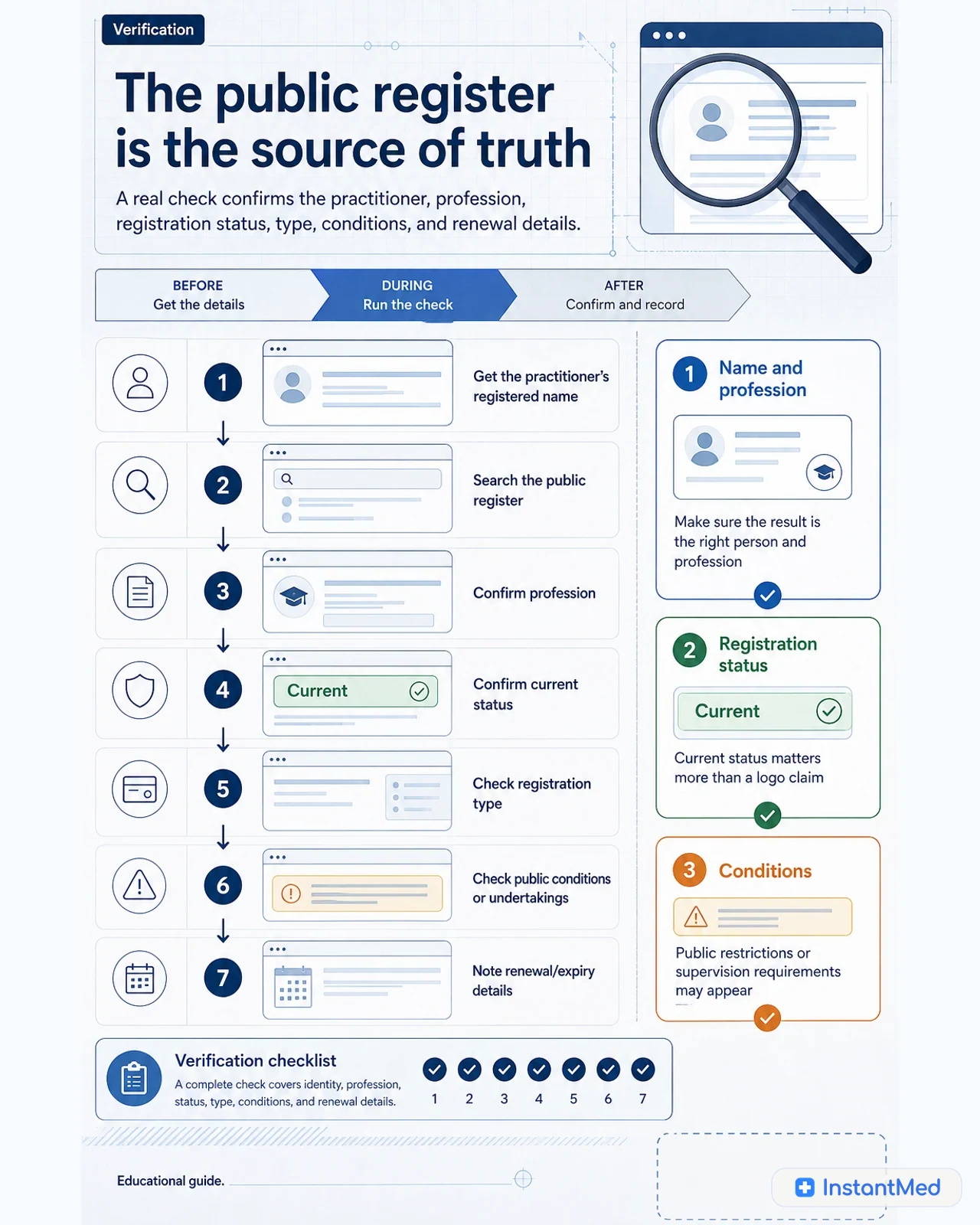
How To Check A Doctor On The Public Register
Ahpra's Register of practitioners is public. You do not need an account to search it.
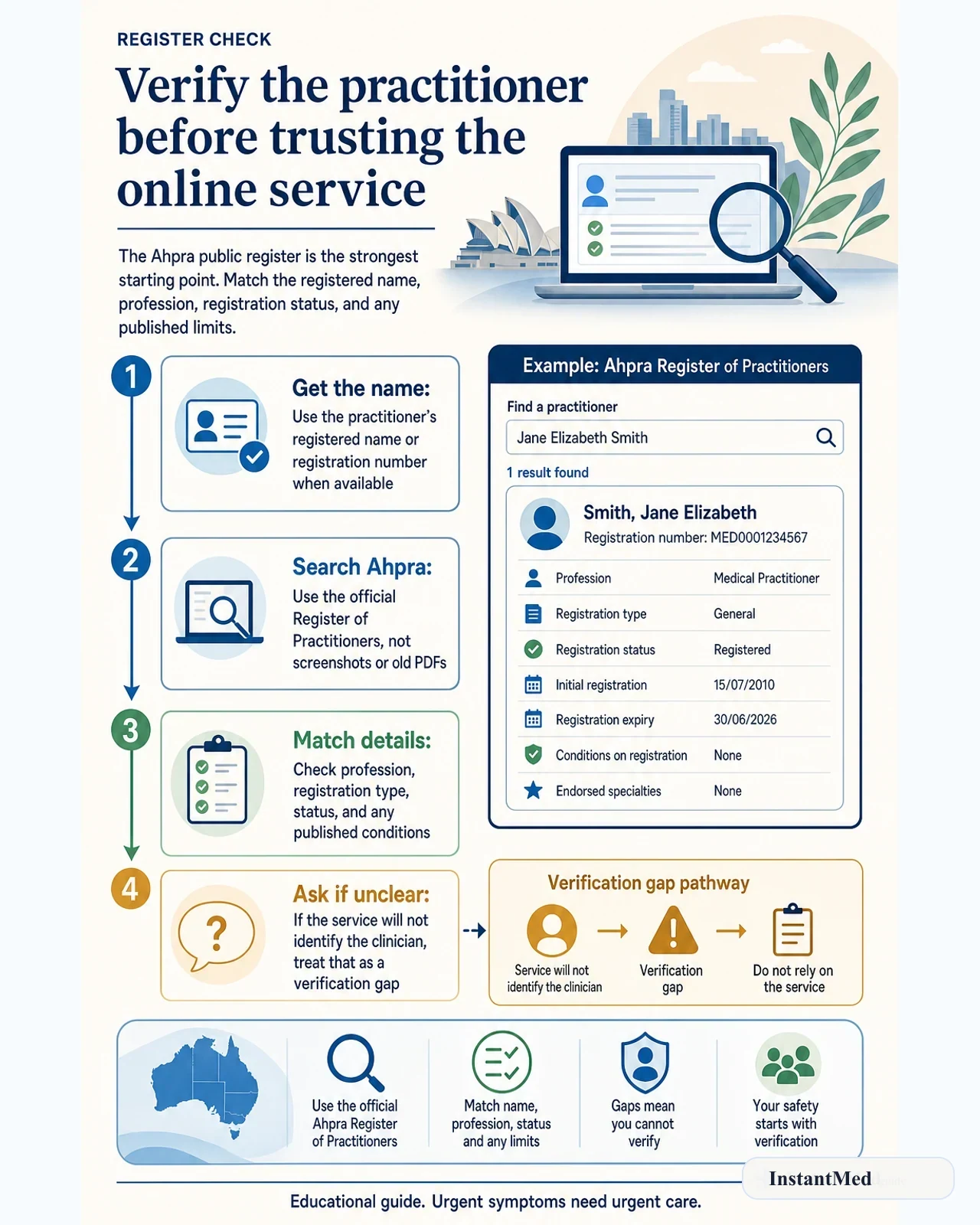
Use this process:
- 1
Go to the official Ahpra Register of practitioners.
- 2
Search by the doctor's registered name or registration number.
- 3
Choose Medical Practitioner as the profession if you are checking a doctor.
- 4
Open the matching result.
- 5
Check the exact name, profession, status, registration type, principal place of practice, conditions, undertakings, and specialist registration.
- 6
If the details do not match what you were told, ask for clarification before relying on the claim.
If a service or clinic will not identify who provided your care, that is not a small UX issue. It stops you from doing the basic public-register check. For a step-by-step walkthrough, see our guide on how to verify an online doctor.
What To Look For In The Result
The register result is not just a yes/no screen.
Check these details:
- Name: Match the practitioner's name to the person or document you are checking.
- Profession: Make sure it says Medical Practitioner if the person is acting as a doctor.
- Current status: Current registration is different from lapsed, suspended, or cancelled status.
- Registration type: General, specialist, provisional, limited, and non-practising registration have different meanings.
- Conditions or undertakings: Public restrictions can limit what the practitioner may do.
- Specialist registration: Relevant if someone claims to be a specialist.
- Expiry or renewal detail: Registration is time-limited and must be renewed.
Important Warning
Do not rely on "doctor-led" or "clinician reviewed" wording unless you can identify the actual practitioner and check their registration.
Registration Types Explained
The Medical Board lists several categories of medical registration.
General Registration
Registration types
General, specialist, provisional, limited, and non-practising registration do not mean the same thing.
General registration is the standard registration category for doctors who have met the requirements to practise medicine without the same direct supervision limits that apply to provisional or limited registration.
General registration does not automatically mean the doctor is a specialist GP. It means they are registered as a medical practitioner in the general category.
Specialist Registration
Specialist registration applies when a doctor is recognised in a specialty. Specialist titles and fields matter because they define the area in which the practitioner is recognised.
If a person claims specialist status, check the specialist registration details, not just the main registration status.
Provisional Registration
Provisional registration commonly applies to doctors in supervised training pathways. It is not the same as unrestricted independent practice.
Limited Registration
Limited registration is granted for defined purposes, such as area of need, postgraduate training or supervised practice, public interest, or teaching and research. It often comes with scope limits or supervision requirements.
Non-Practising Registration
Non-practising registration allows a doctor to remain registered while not practising. It does not permit clinical practice.
This distinction matters. A person can be "on the register" but still not be allowed to provide the clinical service you think they are providing.
Renewal, CPD, And Ongoing Standards
Registration is not permanent.
The Medical Board says the renewal date for general, specialist, and non-practising medical registration is 30 September. If registration is not renewed by the renewal date and late period, the practitioner's name is removed from the register and registration lapses. A practitioner cannot keep practising until their registration details are updated on the register.
Doctors must also meet ongoing registration standards. These include areas such as:
- Continuing professional development
- Recency of practice
- Professional indemnity insurance
- Criminal history requirements
- English language skills where relevant
The Medical Board's CPD framework includes CPD homes, professional development plans, and different types of CPD. The point is not box-ticking. It is ongoing competence and safer practice.
Good Medical Practice Still Applies
The Medical Board's Good medical practice code describes the professional standards expected of doctors registered in Australia. It applies across settings, including technology-based patient consultations and online or remote prescribing.
The code is not just about bedside manners. It covers patient-centred care, communication, privacy, risk management, professional performance, reporting obligations, and the trust placed in doctors who sign certificates or reports.
That matters because registration is not only about getting onto the register. It is about staying accountable to the standards attached to registration.
What This Means For Telehealth
Telehealth does not create a lower standard of medicine.
The Medical Board's telehealth guidance says telehealth can include video, internet or telephone consultations, transmission of digital images or data, and prescribing medicines. It also says telehealth is not suitable for every consultation and should not be treated as a routine substitute for in-person care.
The key practical points are:
- The standard of care should be safe and, as far as possible, meet the same standards as in-person care.
- The doctor must gather enough information to make a safe clinical decision.
- The limits of remote assessment matter.
- Secure records and patient information handling matter.
- A doctor consulting with patients in Australia is expected to be registered with the Medical Board, regardless of where the doctor is located.
This does not mean one-off telehealth is banned. The Medical Board specifically recognises that telehealth can support episodic and emergency care access, including when patients cannot travel or cannot see their usual doctor. The point is appropriateness, not ideology.
Red Flags When Checking A Service Or Practitioner
Be cautious if:
- The practitioner cannot be named
- You are shown a badge instead of a live register result
- The registration type does not match the claimed role
- The register shows public conditions that are not explained
- A person appears registered in another country but not in Australia
- A service claims every request is approved automatically
- The clinical document does not identify the responsible practitioner
- There is no clear complaints pathway
Accountability
The Medical Board's expectations still apply: adequate assessment, clinical judgement, records, privacy, and follow-up where needed.
The register will not answer every clinical question, but it will catch the most basic problem: whether the person is currently registered and what limits are visible.
If You Have A Concern
Ahpra and the National Boards manage concerns about registered practitioners through the notifications process. A concern may relate to conduct, performance, health, boundaries, unsafe practice, dishonesty, or other issues affecting public safety.
The right pathway can vary by state and circumstance. New South Wales and Queensland have co-regulatory arrangements, so some concerns may be handled through state health complaints bodies rather than only through Ahpra.
If the issue is immediate danger, use urgent medical care or emergency services. A regulatory notification is not an emergency response system.
Practical Checklist
Before relying on a doctor's credentials, check:
- Is the practitioner listed on the official Ahpra register?
- Does the profession say Medical Practitioner?
- Is the registration status current?
- What registration type is shown?
- Are there public conditions or undertakings?
- Is specialist registration shown if specialist status is claimed?
- Does the name match the person or document?
- Does the care model make sense for the problem?
- Is there a complaints pathway if something is wrong?
That is the real meaning of AHPRA-registered: a live, checkable regulatory status attached to ongoing professional obligations.
Sources
- Ahpra: What we do
- Ahpra: Register of practitioners
- Medical Board of Australia: Types of medical registration
- Medical Board of Australia: Registration standards
- Medical Board of Australia: Registration renewal
- Medical Board of Australia: Continuing professional development
- Medical Board of Australia: Good medical practice
- Medical Board of Australia: Telehealth consultations with patients
Frequently Asked Questions
What does AHPRA-registered mean?
It means the practitioner appears on the public Ahpra Register of practitioners and is allowed to practise within the scope and limits shown on that register.
Does AHPRA registration mean a doctor is a GP?
Not automatically. A doctor may have general registration, specialist registration, provisional registration, limited registration, or non-practising registration. GP status is a specialist/vocational question, so check the register result carefully.
How do I check if a doctor is registered in Australia?
Use Ahpra's public Register of practitioners. Search by name or registration number, select Medical Practitioner, then check the current status, registration type, conditions, undertakings, principal place of practice, and any specialist registration.
Can an overseas doctor treat Australian patients by telehealth?
The Medical Board expects a doctor consulting with patients in Australia to be registered with the Board and to meet the relevant registration standards, including recency of practice, CPD, and professional indemnity insurance.
What if a practitioner's registration is lapsed or suspended?
A practitioner whose registration has lapsed, been suspended, or been cancelled should not be treated as currently able to practise. The public register is the safest place to check current status.
Does AHPRA check every consultation?
No. Ahpra and the National Boards set standards, register practitioners, monitor compliance, and manage concerns. Registration does not mean every individual consultation has been pre-approved.
InstantMed Medical Team
Related Articles
10 min read
How to Verify an Online Doctor in Australia
Before using an online doctor or telehealth service, check the practitioner, the service, the clinical process, and the document you receive. This guide explains how to verify legitimacy without relying on trust badges.
InstantMed Medical Team
9 min read
Is Telehealth Safe? Everything You Need to Know
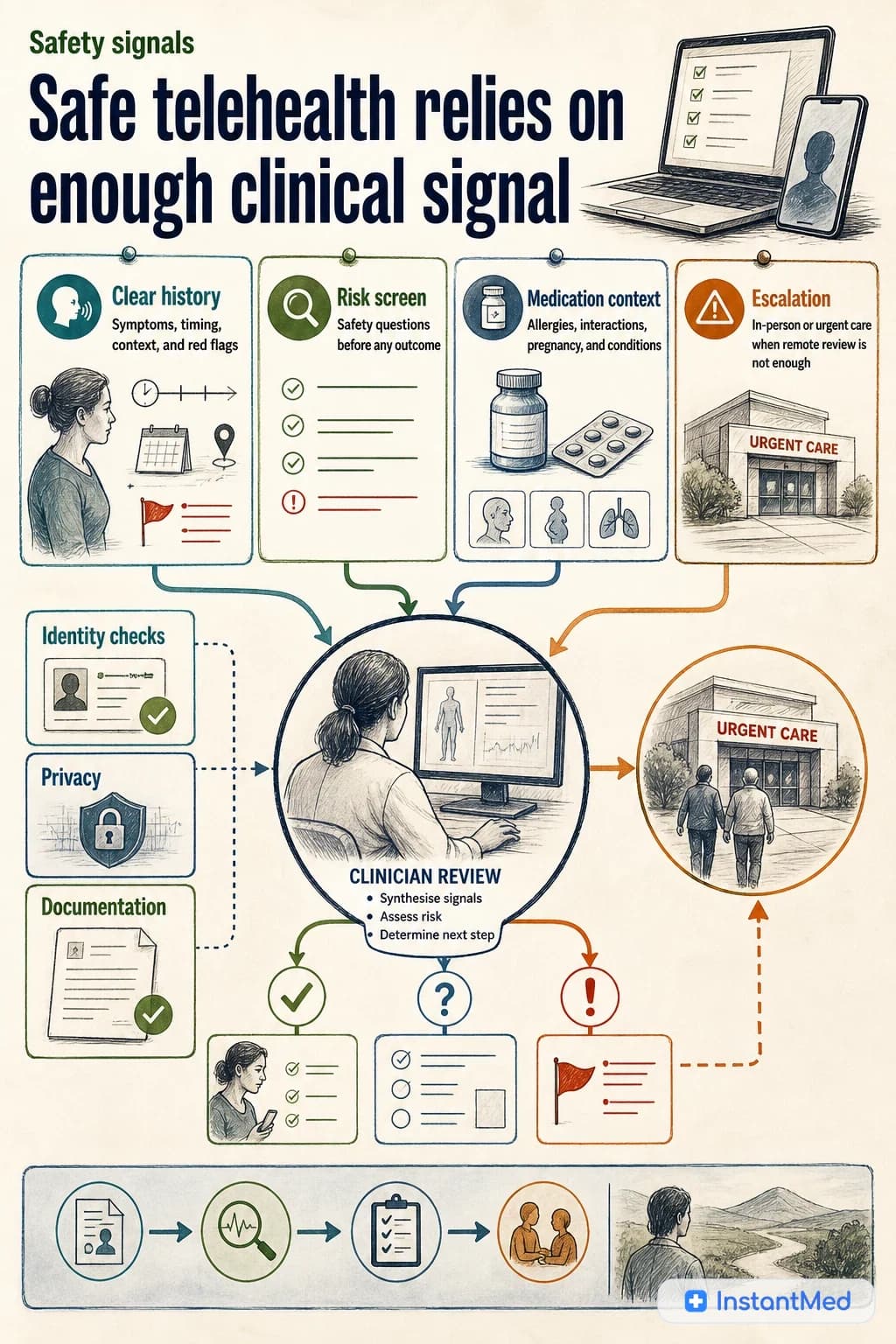
Yes, telehealth is safe when used with a legitimate service. Here is how to verify doctor qualifications, what data protections apply, and the red flags that identify unsafe services.
InstantMed Medical Team
7 min read
Telehealth Privacy and Security in Australia
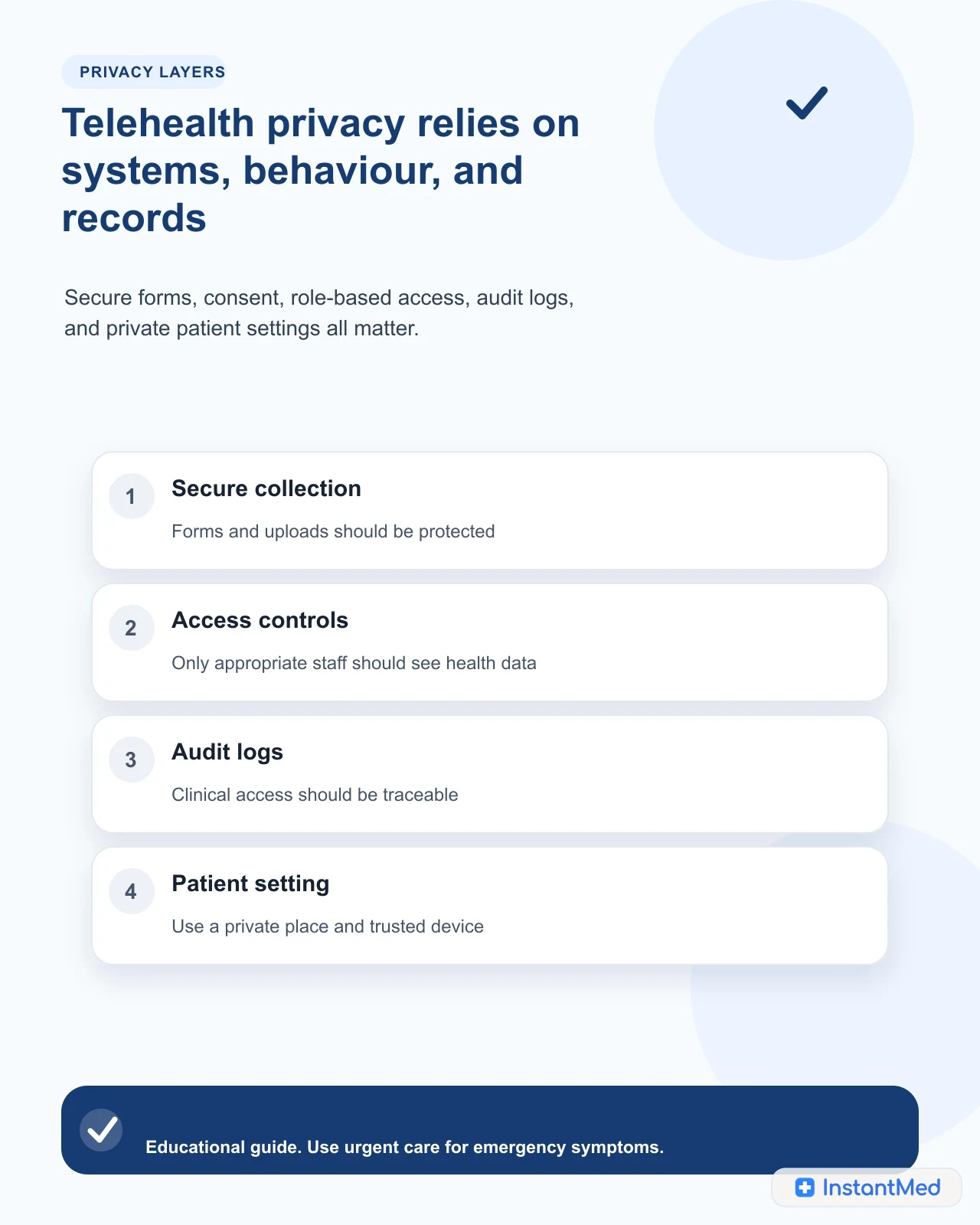
Telehealth services hold your most sensitive personal information. The Privacy Act 1988 and Australian Privacy Principles set out binding obligations for how that data is collected, stored, and used. Here is what those protections actually mean for you.
InstantMed Medical Team